info@spgtechsoft.com





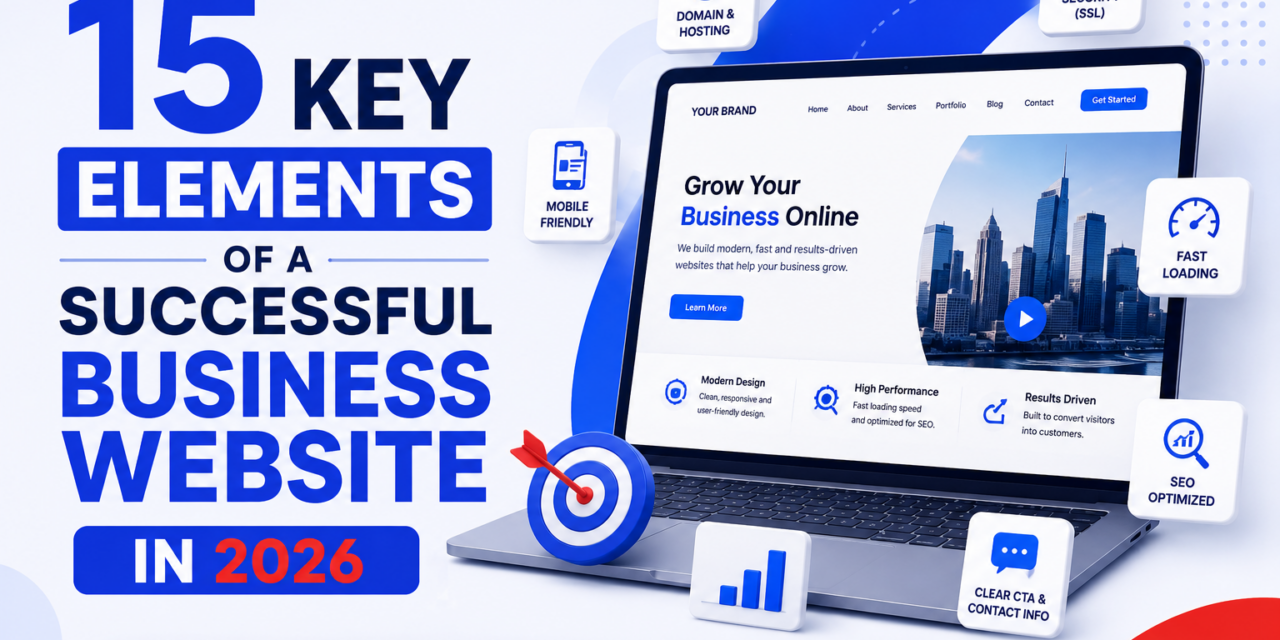
15 Key Elements of a Successful Business Website in 2026
In 2026, just having a website is not enough for companies. Along with a website, businesses also need a fast, safe, accessible, and well-optimised website for search engines to boost conversions.
Great websites combine design, technology, marketing, analytics, automation, and user experience to attract visitors. All aspects of a website, such as how it loads and where calls to action are positioned, play a vital role in making visitors stay or leave.
Today’s consumers expect websites to function properly on mobile devices, give quick access to information, provide effective means of communication, and deliver an overall pleasant online experience, while businesses require reliable data to analyse their performance.
15 Features Built For Conversions And Long-Term Growth
1. Mobile-First Design
The vast majority of web traffic is generated by smartphones and mobile devices. So, mobile-first design becomes one of the key factors of contemporary business web design.
Mobile-first websites are designed for small screens first and tweaked afterwards for tablets and computers. This way, the core content and functions of the site can be conveniently accessed regardless of the size of the screen.
Key points include:
- Responsive layouts
- Navigation that is easy to understand
- Readability of fonts
- Buttons friendly for touch devices
- Properly optimized graphics
- Forms friendly for mobile devices
- Quick operation in mobile networks
A potential customer should be able to find out about your services, reach you, ask questions or even make a purchase without any difficulties.
2. Fast Loading Speed
When planning website performance, keep in mind the importance of
Image compression
Coding efficiency
Caching in the browser
Optimising delivery of web content
Reducing unnecessary coding
Choosing the right font
Using quality hosting services
Introducing modern image formats
Speed is a critical factor to enhance user experience and business opportunities.
3. SSL Certificate and Web Security
Trust is vital for users when sharing their information online.
An SSL certificate enables the establishment of a secure connection between the user’s browser and the website.
Presently, HTTPS is a must for any advanced website, especially when a user is asked to leave his or her contact details, set up an account, or make a payment.
To be secure, a website must implement its security strategies, among which are:
- Secure login framework
- Tight access security
- Regular updates
- Use of safe forms
- Reliable backups
- Malware monitoring
- Protecting against the common threats associated with websites
4. Effective Lead Generation Forms
In case one of your main objectives is to generate inquiries, having lead forms that are well-designed is important for the website.
Lead forms are supposed to gather all relevant feedback in order to start a conversation without bothering visitors with unnecessary questions.
Depending on the field of business, forms can include:
- Name
- Phone number
- Company name
- Service needed
- Details of the project
- How you want to be contacted
Forms can be located on service pages, landing pages, contact pages, popups, and in other areas where there is high intent.
It should be as easy as possible. A well-designed form, along with clear writing and a strong CTA, can boost the chance of successful lead generation.
5. WhatsApp Integration
In today’s world, quick communication with customers is preferred over long contact forms or emails in many businesses.
With the WhatsApp integration, visitors have the opportunity to directly reach the business by using the website.
The button can be placed at the following locations:
- Homepage
- Service pages
- Product pages
- Contact page
- Mobile version
- Landing pages
With the help of the WhatsApp platform, businesses can respond to queries, give information, send quotes, follow up with prospects, and assist customers.
Nevertheless, it is possible to do the integration wisely. The button should be visible but not annoying.
6. CRM Integration
Lead generation is merely the initial stage. Companies must also have an effective strategy for handling those leads.
CRM integration enables inquiries from the website to directly enter a customer relationship management system.
Rather than having the information taken from emails or spreadsheets, businesses can easily automate lead generation and management.
Having a CRM-connected website enables businesses to do the following:
- Store client details
- Allocate leads to sales departments
- Keep track of follow-ups
- Monitor the status of leads
- Automate notifications
- Keep a file of communication
- Track sales performance
This may significantly cut down on administrative work and facilitate prompt responses to leads from sales teams.
7. Analytics And Visitor Insights
It isn’t enough for a webpage to simply generate traffic; it is also important that the generated traffic should be useful information with regard to a visitor’s behaviour.
Analytics tools have the means to give insights to businesses regarding:
- Where a visitor arrived from
- Which pages are the most popular
- The page engagement time
- Which devices are being used by visitors
- The pages from which a visitor leaves the site
- The pages through which a visitor has made a request
- The best-performing sources of marketing
With the information provided, a business can make a decision based on the correct facts instead of empty assumptions.
For instance, if a certain page is very popular but requests resulting from this page are few, the business may analyse its content, call-to-action method, placement of request forms, price rates, and user experience.
8. SEO-Ready Website Architecture
Search engine optimization should not come after the fact, but rather be implemented while creating the site.
SEO-centric designed sites allow search engines to comprehend how the website is organised.
Essential elements include:
- Proper URL structure
- Consistent subtitle structures
- An ability to access links easily
- Organising link structure
- Having an XML website map
- Using canonical websites
- Meaningful titles in metadata
- Mobile friendliness
Having a website layout that is easy to follow by users, too.
It is crucial for companies that offer different products or services to come up with a logical site design.
9. Schema Markup
Structured data, also known as schema markup, can enhance the knowledge of the search engines concerning the information given on the website.
According to the types of business and content, the useful structured data may include information about
- Organizations
- Local businesses
- Products
- Services
- Articles
- Events
- FAQs
- Reviews
Properly utilised structured data helps search engines interpret the content of the website and, if eligible, provide benefits related to the search results.
It is vital to apply schema markup correctly and in line with the guidelines instead of using it merely for the purpose of getting better rankings in search engines.
10. Strong Calls to Action
The visitor of the website must know what to do next.
Effective CTAs can direct visitors toward the desired course of action.
Some examples are:
- Request a Quote
- Schedule a Consultation
- Request a Call Back
- Initiate Your Project
- Buy Now
- Connect With an Expert
- Download the Brochure
Every CTA must be appropriate for the visitor’s stage of the buyer’s journey.
A visitor reading an introductory blog may need a gentle CTA, while an individual who is browsing the service page might require a direct action.
Placing CTAs correctly will help change the visitors from passive to active ones.
11. Content Management System (CMS)
A content management system offers organisations the capability of controlling content on their website without the need for developers for every little modification.
A good CMS will enable authorised people to modify it.
- Website pages,
- Blogs,
- Pictures,
- Services,
- Products,
- FAQs,
- Case studies,
- Advertisements.
This option comes in handy for companies that deal with constant publication and modification of their services or products.
A content management system needs to be chosen according to the requirements of a particular site, security needs, scalability, and technical capabilities rather than solely by brand popularity.
12. Conversion Tracking
Just the traffic numbers only lead you to know if you are doing business through your website.
Through conversion tracking, businesses can measure actions performed by the visitors on their websites.
Some of these actions may consist of:
- Forms delivered
- Calls made
- Clicks on WhatsApp
- Items purchased
- Requests for appointments
- Documents downloaded
- Account created
- Newsletters subscribed
It is through conversion data that a business can understand which web pages, campaigns, keywords, as well as sources of traffic, lead to business impact.
For instance, if an advert campaign produces millions of visitors but only a few inquiries,s the problem might lie with the quality of traffic itself or the landing page.
With conversion tracking, businesses can make marketing decisions based on results rather than vanity metrics.
13. AI Chatbot
AI chatbots are being found to increasingly leave a mark on various business websites.
- AI chatbots proffer immediate help when site visitors have a query about a product, service, pricing and availability, and even a company.
- As for its application, an AI chatbot can:
- Provide answers to FAQs
- Direct visitors to appropriate pages
- Get any information about potential customers
- Evaluate leads
- Assist customers in exploring product information
- Provide primary customer support
- Provide users with ways to contact the site
Chatbots are to work with human customer service in a unified way.
No doubt AI chatbots should provide information in a correct manner and also be explicit concerning their limitations and the possibility of getting assistance from human representatives of customer service.
14. Accessibility
A good quality website must be user-friendly for the maximum number of users, including those who have disabilities.
Accessibility relates to the way the website is built and designed to give an opportunity to users to access information by using different devices and assistive tools.
Some of the key points to consider when designing an accessible website are:
- Appropriate colour contrast
- Navigation by means of a keyboard
- The existence of alternative texts for pictures that have meaning
- Links that explain the content
- The way headings are organised
- Forms that can be filled easily
- Revealing mistakes that might have been made
- Captions or transcripts where needed
- The content that can be used in
- Accessibility is compliance, but it does create an improved user experience and helps companies reach larger groups of people.
15. Performance Optimization
Performance optimisation is not just about making a website faster.
High-performing sites must be constantly monitored and improved as their content, traffic, integration, and functionality evolve.
Performance optimisation can include:
- Removing unnecessary coding
- Optimising JavaScript and CSS
- Image compression
- Improving server response time
- Optimizing databases
- Using cloud storage
- Reducing third-party scripts
- Monitoring Core Web Vitals
- Making a mobile-friendly website
Performance is also important after the site is launched. Adding more plugins, tracking tools, and videos can greatly impact performance.
Regular checks will allow the business to be sure that it is still fast and reliable.
How Do These 15 Features Work Together?
The strength of a website that converts visitors lies in the relationship between its characteristics rather than viewing them separately.
For example, a potential client can enter your website after searching on Google, which is results-oriented.
The user finds his way to an effective, easy-to-navigate mobile version of your services page, sees great copy, and an attractive call to action.
They fill out a lead generation form, and their details will be put into your CRM system automatically. The analytics track the conversion, while the sales team is notified about it. If the user has any further questions, an AI chatbot and WhatsApp integration will help with further communications.
This way, a complete digital journey can be represented as follows:
Search → Website → Engagement → CTA → Lead → CRM → FollowUp → Conversion
That is what makes a contemporary business website a tool for better promotions instead of mere representation of a company.