info@spgtechsoft.com





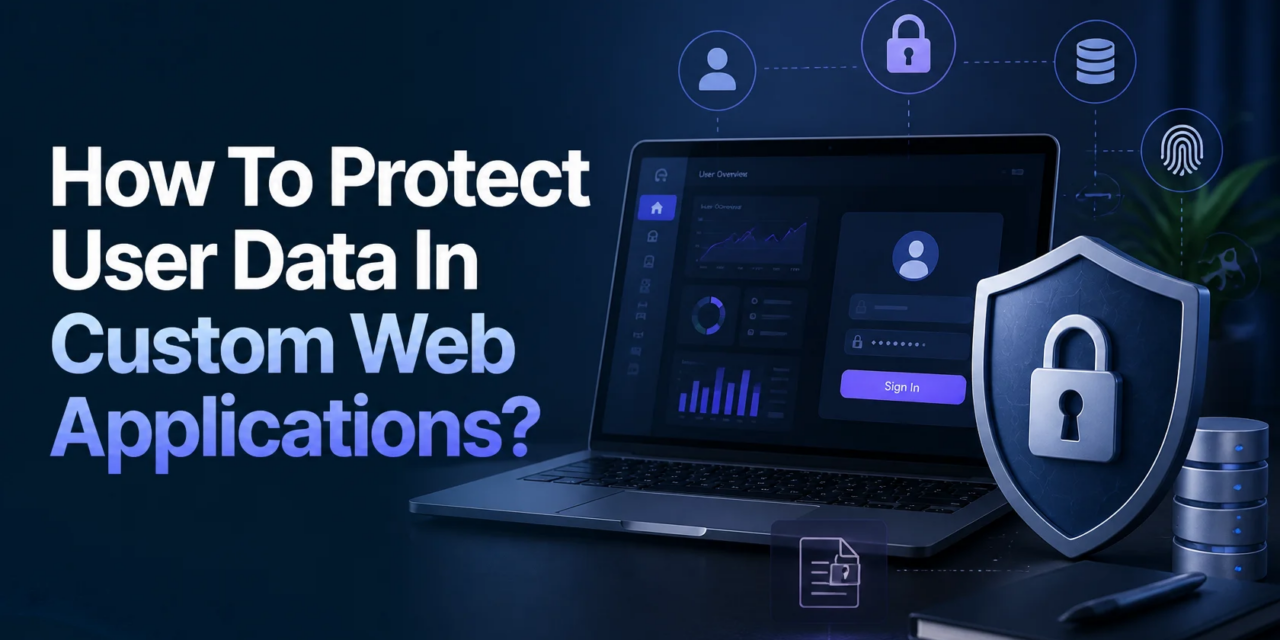
How To Protect User Data In A Custom Web Applications?
Custom web applications are significant in modern business processes. They serve various functions such as e-commerce, customer relations, payment processing, consultancy, health services, educational services, booking platforms, etc. As such applications deal with sensitive information, it is crucial for companies and software developers to protect user data. In this article, we will understand how custom web application development in Mumbai protects user data in custom web applications.
What Are The Various Forms Of User Data In Web Applications?
1. Personal Information:
This includes the basic information required to identify users, such as their names, ages, genders, addresses, phone numbers, and email addresses. This information is most often collected through profile registration forms.
2. Login and Authentication Data
This includes all such information as usernames, passwords, authorisation tokens, answers to secret questions, and two-factor authentication. This information is considered very sensitive and needs to be protected securely.
3. Financial and Payment Information
Financial and e-commerce applications may require the processing of banking information, transaction history, billing information, and payment methods. This information is included in the most sensitive data and, therefore, it needs to be secured quite thoroughly.
4. Data On Contacts
Many applications may obtain users’ e-mails, phone numbers, home addresses, or preferences regarding communication with the purpose of providing customer service and support or for marketing.
5. Geo-Location Information
Some applications provide information about the user’s country of residence, town, approximate location, or exact location in connection with location-based technology.
Why Is It Important To Protect User Data?
- Mitigate Data Breaches
With the proper security protocols, the danger of unauthorised access to personal, financial, and commercial data is minimised.
- Enhances Customer Confidence
People are more willing to use a website or app if they feel that their data is used safely and securely.
- Secures Sensitive Data
Sensitive files are another way to refer to files that may contain passwords, contacts, payment information, and other personal information. Protecting this information prevents identity theft from happening.
- Minimises Monetary Losses
As it was noted above, a data breach is a source of monetary loss caused by fraudulent activities, loss of business opportunities, recovery costs, and the chance of receiving penalties.
- Ensures Privacy Legislation Compliance
Depending on the area of their business, various companies are obliged to follow certain regulations regarding data collection and usage.
- Safeguards Brand Reputation
The occurrence of security breaches can harm the reputations of businesses as well as lead to difficulties in keeping old customers and winning new ones.
- Blocks Illegal Access
Utilising authentication, authorisation, cryptography, and access measures, businesses can be sure that only authorised users gain access to the data.
- Supports Company Stability
Secure systems, monitoring tools, and trustworthy backup techniques enable companies to recover from cyberattacks efficiently.
10 Important Practices Businesses Can Follow To Protect User Data In Custom Web Applications.
- Strong Authentication Solutions
Authentication acts as a necessary part of the security of an online solution, as it makes sure that only authorised individuals can proceed with their personal accounts and utilise specific features of the application. Custom software solutions should make a strong effort and incorporate strong forms of authentication rather than sec relying on username and password combinations only.
One of the popular solutions for web application developers is the implementation of multi-factor authentication that requires the user to provide one more factor of authentication along with the password. It can be an authentication app, a one-time password, a security token, or another type of approved method. This way, in case the password is compromised, accessing the account becomes much more difficult.
Making authentication safe (including the implementation of account lockout or rate-limiting solutions) can help avoid making too many attempts to guess the password and lessen the chances of unauthorised access to the account.
2. Encrypt Important User Information
Enterprise web application development in Mumbai provides encryption service. Encryption plays a vital role in safeguarding data. Important information should be kept protected both in transit from the user’s web browser to the application and while it sits in storage on the servers or databases.
Web applications should ensure the use of HTTPS with properly set up TLS. This way, it is possible to avoid online attacks aimed at intercepting sensitive information during communication.
Likewise, sensitive information stored in databases should be given the required protection. Encryption of the stored data can be used to lessen the consequences of a database breach. Nonetheless, it is important to ensure the proper use of encryption methods and keep the encryption keys secured from the encrypted data, if possible.
3. Store Passwords Securely
Passwords must not be stored in their original or raw form. If a hacker gets access to a database containing passwords in plain text, all user accounts become automatically vulnerable.
Instead, applications are recommended to implement provable hashing algorithms that are specially developed for password storage purposes, such as Argon2id, bcrypt, or scrypt. Password hashing is a special process in which passwords are transformed into unrecognisable formats.
It is also mentioned that developers should work on creating strong passwords and avoiding the use of passwords that are often used. Password Reset should use secure and limited-time access tokens instead of sending original passwords to users.
4. Implement Adequate Access Controls
The process of authentication is used to identify the user, while authorisation is used to define the user’s rights. Both processes are important to secure user information.
For instance, an employee who has the right to look through customer data does not have the permission to change any information concerning finance. In a similar way, a regular customer does not have to be given access to the administrator section.
Custom applications must follow the principle of least privilege, which means that users and components should be given only the required permissions. Access controls should be applied on the server side, not only in the user interface of the application.
In order to identify unnecessary access rights, regular audits of user privileges should be conducted.
5. Safeguard The Database
The database represents one of the major targets for hackers, since it often contains a lot of user data. Hence, database security should be a priority during the process of custom web application development.
Developers must implement parameterised queries or prepared statements so as to minimize the risk of SQL injection attacks. Database access credentials should have limited permissions, and administration passwords should not be unnecessarily visible to application users.
Companies must also ensure secure backups and protection of backup files. Even a backup with confidential information can pose a threat to security if it is kept without the necessary access limitations or encryption.
6. Validation And Sanitisation Of User Input
Most vulnerabilities of web applications are caused by untrusted user inputs. Malicious actors can try to insert harmful scripts, commands or unexpected information into URLs, forms, APIs, etc.
Input validation should be performed on the server side, so that submitted input is limited and meets the expected format at the same time. Thus, for instance, the email field should be validated by ensuring that the given input is indeed an email, while numerical fields should not accept any characters other than numbers.
In addition to this, encoding output and performing proper sanitisation helps mitigate the impact of cross-site scripting attacks.
7. Preventing Cross-Site Scripting And Request Forgery
Cross-site scripting can lead to the execution of malicious scripts within the user’s browser if the application fails to manage unsafe data correctly. Depending on the severity of the flaw, attackers may either try to obtain user session data or make changes to web pages or execute transactions in the name of users.
Developers should ensure that they are encoding output in a suitable manner depending on each scenario and employ appropriate security policies whenever possible.
Applications must be designed to thwart CSRF as well, ideally, when browser sessions are used for authentication of relevant requests and transactions. CSRF tokens and relevant cookie settings, as well as other security mechanisms provided by the frameworks, can prevent unauthorised requests.
8. Securing APIs And Third-Party Integrations
Many custom web applications today utilise APIs and integration with third-party services. In particular, payment processing companies, analytical systems, cloud-based solutions, identity verification tools, shipping systems, and customer relationship management systems all communicate with applications.
In order to ensure their security, APIs must implement robust authentication as well as authorisation procedures. In addition, crucial API keys and authentication secrets must not be hard-coded in publicly available source code or shared through front-end code.
API endpoints must be equipped with rate restrictions, input checking, and access permissions, as well as monitoring mechanisms. As for third-party integrations, they must be checked properly, because vulnerabilities in external components can put the whole application at risk.
9. Implement Secure Session Management Techniques
Session management allows users to maintain a verified identity within a web application once they have logged in. In the case of poorly executed session management, account security can be compromised even if the system takes appropriate authentication measures.
Systems must make use of session identifiers that are random and safe, and cookies should be safeguarded using attributes like Secure and HttpOnly. Based on the specifics of a web app, SameSite cookies may also add another layer of protection against attacks.
Regardless of how secure the system is, sessions must be allowed to expire if a user is inactive for a certain period of time. Moreover, users should always have the option to terminate their sessions if needed.
10. Update the Software and Dependencies Regularly
Custom software often depends on frameworks, libraries, plug-ins, operating systems, databases, and third-party software. Vulnerabilities in these platforms can sometimes be discovered after the software has been deployed.
As such, web application development company in Mumbai must ensure that they keep track of significant dependencies and introduces security updates in a disciplined way. If the software is vulnerable or not supported, the development team needs to replace it accordingly.
Automated scanning of dependencies may be done to identify known vulnerabilities. Nevertheless, automated solutions cannot fully substitute for human security review and testing.